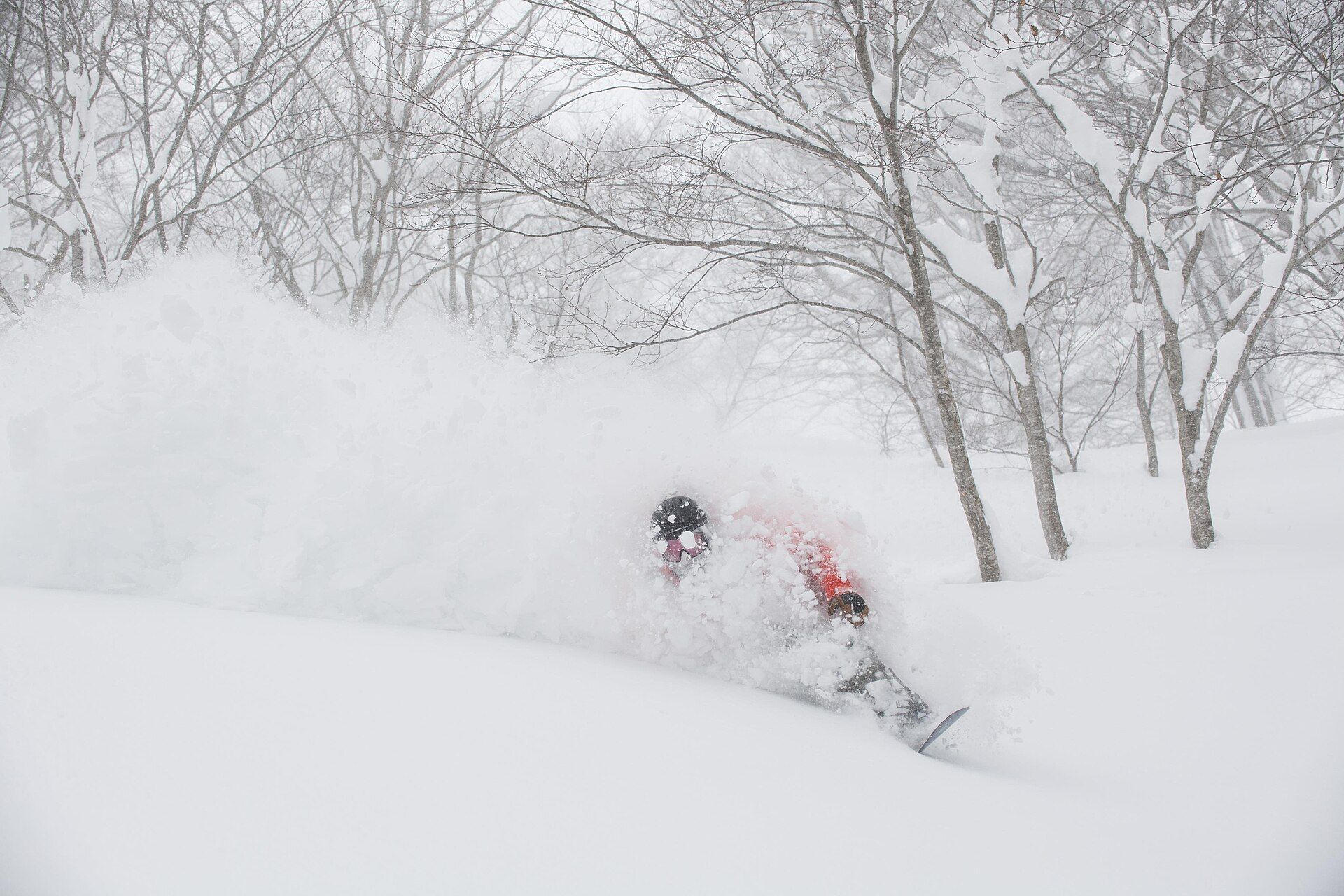
Powder rewards flow: carry appropriate speed, steer progressively and keep your line inside open, permitted terrain.
Photo: Sawa-loveLicenseYour first powder day: stay loose and keep moving
Powder turns the familiar mountain quiet and three-dimensional. Keep the nose free, the board moving and your partner close enough to matter.
Start with controlled snow, not a heroic line
Pick an open, in-bounds run below your normal difficulty. Fresh snow hides ruts, branches, creek holes and the shape of the slope; it also makes standing up and traversing far more tiring. Learn how the board floats where patrol, trail signs and lift access still support the day.
Deep snow around trees creates snow-immersion and tree-well hazards even inside some resorts. The National Ski Areas Association advises riding with a partner who stays within viewing distance. Agree on short meeting points and stop where you can actually see each other—not at the bottom after one rider disappears into the trees.
Give the board a powder setup—not a rescue setup
Use the board maker’s reference powder stance if it has one. Moving both bindings one insert pack towards the tail can add usable nose and reduce the effort needed to plane, but preserve your stance width and stay within the manufacturer’s mounting guidance.
A directional or volume-shifted powder board can make deep snow easier, but normal all-mountain gear is enough for many first in-bounds powder days. A fresh, temperature-appropriate wax helps glide on flat exits. None of these changes replaces balanced movement.
- Move both bindings together when adding setback
- Photograph the original stance before changing it
- Keep toe and heel overhang balanced
- Do not buy a longer or wider board outside its weight guidance just for one storm
Weight distribution
Where your weight sits along the board
Plan view, nose to the right. The bar shows how pressure is shared between the front and rear foot, and the figure shows where the hips end up.
Centred
Weight split close to even, a shade toward the front foot on a directional board. This is the position to return to between turns.
Both ends of the edge work, so the board holds a line and responds when you ask it to.Starting a turn
A moment more pressure over the front foot as the new edge goes in, so the nose engages and starts drawing the arc.
The turn begins from the front of the board instead of being twisted from the back.Deep snow
Deliberately back-biased so the nose planes up rather than diving. Ride the whole board, just with the balance point moved back.
The nose stays on the surface. Hold it too long on a groomer and the board will not turn.The back seat
Hips behind the rear binding, usually because the slope looks steep. Almost every rider does this in their first season.
The nose lifts, the front of the edge stops gripping, the board runs straight and gets faster — which makes the rider lean back further. It is the single most common reason turns stop working.Find planing speed before making big turns
A snowboard floats once enough surface area is moving through the snow. Enter the run with modest momentum and choose a line that keeps flowing. Starting too slowly, traversing uphill or braking hard in the deepest pocket lets the tail sink and the nose climb until the board stops.
Keep both legs active with a slight preference towards the rear foot when the nose needs help. If the back thigh is on fire after one pitch, you are probably sitting on the tail instead of standing over a planing board. Reset taller, bring the hips back over the bindings and use setback or a more open line rather than a permanent squat.
Make patient, three-dimensional turns
On groomed snow, the edge cuts a firm platform. In powder, the whole base bends and pushes against soft snow. Guide the board with smooth pressure and let each turn develop; a sudden heel-edge brake throws a wall of snow at the nose and kills momentum.
Use a gentle flex-and-rise rhythm. Lighten the board as you begin the turn, then flex as it comes around and pressure builds. Look through open spaces, keep the upper body calm and allow the legs to steer beneath you. The turn can be round without finishing so far across the hill that you stall.
- Eyes stay on the next open lane, not the nose
- Pressure changes are smooth and patient
- Turns keep enough downhill travel to preserve float
- Use smaller movements when the snow is very deep or slow
Related lesson
Watch the movement.
This clip matches the guide. YouTube loads only when you press play.

Intermediate / Powder basics / 4:59
Prepare for your first powder day
By SnowboardProCamp
Intermediate / Powder basics / 11:59
How to ride powder and have more fun
By Malcolm MooreRead the places powder steals speed
Flat cat tracks, creek bottoms and long low-angle exits can turn a dream lap into a waist-deep walk. Before dropping, identify the fall line and the exit. Carry extra speed into flats, stay in an established track when appropriate and avoid sharp turns that scrub momentum.
Chopped powder asks for softer legs and a more adaptable line. Hidden bumps will move the board vertically; let the knees absorb them rather than stiffening and getting launched towards the nose. Rest before the rear leg becomes too tired to steer.
Fall, breathe and rebuild the platform
If you fall in open powder, do not immediately fight straight uphill. Roll so the board comes below you, pack a small platform with your hands or forearms and use the board’s surface area to help you rise. Clear snow from the binding interfaces before continuing.
A fall near a tree, depression or creek is different. Call to your partner and treat difficulty breathing or self-extracting as an emergency. The fun rule is simple: open in-bounds powder first, trees only with the terrain knowledge, partner discipline and resort guidance they require.
Know exactly what the boundary changes
A resort gate is not an invitation with nicer typography. The National Avalanche Center notes that lift-accessed terrain beyond the boundary is backcountry: avalanche mitigation and rescue expectations change immediately. In some countries, ungroomed or “off-piste” terrain inside a resort may also be uncontrolled, so learn the local system.
Do not leave controlled terrain on the strength of a technique article. Backcountry and uncontrolled off-piste riding require formal avalanche education, the local forecast, rescue equipment you know how to use and partners who make decisions together. Tracks are evidence that somebody went—not evidence that the slope is safe.
Profile-led equipment
What a powder day asks for
Flotation and staying dry, in that order. These are profiles, not picks.
- Demo before buying · Useful nextOptional profile examplesSee market examples
All-mountain board demo shortlist
A broad category to test after rental days—not a claim that one brand, flex or profile works for everyone.
Check: Treat rider weight and boot-compatible width as non-negotiable, then demo different flex and camber or rocker profiles on the terrain you ride.Before buying: Board choice gets personal fast. Treat retailer results as a market scan, then talk to a good shop and rent or demo before committing.
- Vision · Start hereOptional profile examplesSee market examples
Snow goggles + low-light lens
Protects the eyes and keeps terrain features readable in wind, snow and flat light.
Check: Test with your helmet and choose a lens for the conditions you ride most. - Storm layer · Start hereOptional profile examplesSee market examples
Waterproof shell jacket
Blocks wind and wet snowfall while letting you adjust insulation underneath.
Check: Look for usable vents, helmet-compatible hood movement and cuff overlap. - Hands · Start hereOptional profile examplesSee market examples
Waterproof gloves or mitts
Keeps hands protected during storms, binding work and long lift rides.
Check: Test dexterity on buckles and make sure cuffs overlap your jacket cleanly.